


In one of our previous blog posts, we talked about some of the challenges that can come from transitioning from military to civilian life.
But we recognise the transition into Defence from civilian life can be just as tricky.
If you or your partner are at the very beginning of your Defence career, particularly if you’ve had experience in the civilian workforce before joining, this post can help prepare you for some of the challenges and changes you may face.
Our advocacy around family transition
The DFA team primarily comprises people who are civilian partners (or former partners) of current or former serving ADF members. We each became recognised partners or family members at different points in the serving member’s journey.
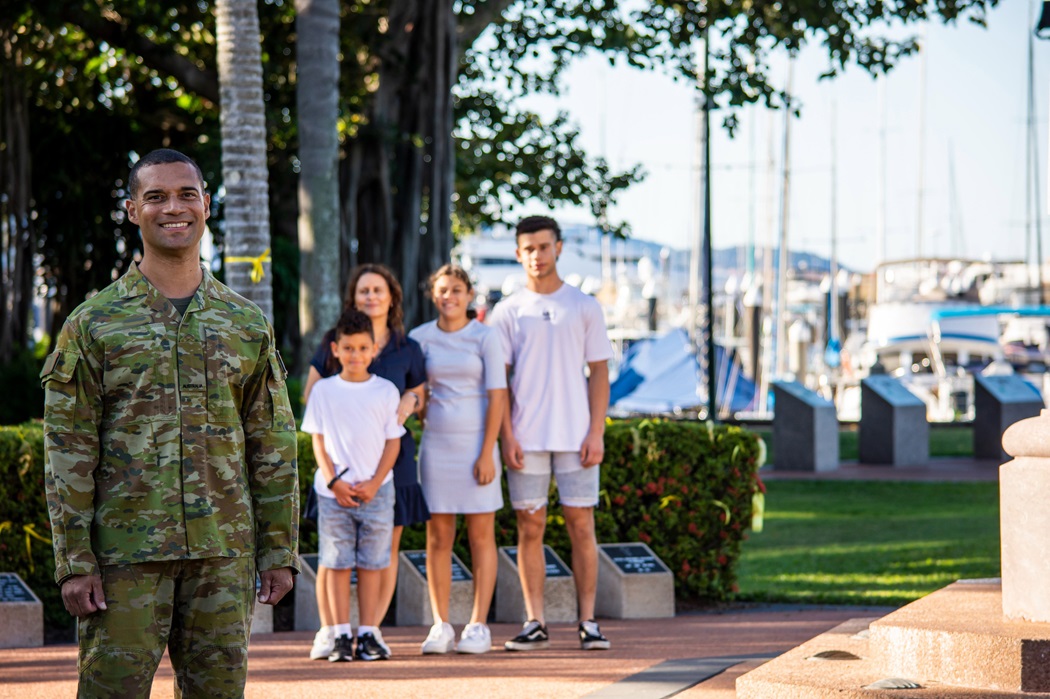
We recognise there are many joining the military who bring their families, including a partner and children along for the ride.
DFA has been advocating strongly over the last few years for improved communication to families.
Families are increasingly looking for timely and accurate information from Defence to help them plan. This may include things like expectations around their loved one in uniform being away, knowing when to expect to move for work (known as a ‘posting’), and benefits their family may be eligible for.
We have suggested that Defence improve the quality of and increase their touchpoints with families, to allow family members to find the information they need, when they need it, at the point that it is relevant to their family.
What to expect when you transition in
The short answer is, be prepared for anything!
Signing up for a career in the military is a meaningful and life-changing commitment to serve Australia, and this brings with it unexpected benefits as well as challenges, particularly if you’re used to how things work as a civilian.
Hurry up…and wait
One of the most surprising things about military life is how things can happen at very different paces, at different points in your journey.
From when you first fill out paperwork with ADF Careers to express interest in joining, to actually walking onto a base with your belongings to commence training, it can take months or even years, depending on whether additional medical tests and clearances are needed.
On the flip side, once the serving member is through basic training, you may find that things progress at a rapid pace, only to slow down again, depending on when further training courses are run and what their future role may be.
From there, it could be weeks or months (or even years) before they are fully trained and assessed as competent to perform a specific role or job. Throughout their career, they will also undertake training regularly as they move laterally to new roles or are promoted and need upskilling.
Some people may find this lack of clarity around timing stressful. While we wish we could tell you it will pass, we also recognise this varies from service to service, and from role to role.
Lifestyle changes
In addition to the speeding up and slowing down of time, particularly while your loved one is undergoing training, families may find it challenging at first to accept that many things will be outside of your control for some time.
Most significantly, the ADF member may not be able to plan too far ahead for time off, even for significant events such as family reunions, weddings, or honeymoons.
Overseas holidays may also be something your family will have to go without for a while, as a serving ADF member will have to be approved to take time off before travelling internationally.
Serving members of the ADF also need to be physically fit for duty; this may mean a change to daily routines to incorporate exercise, and changes to their diet or recreational activities.
For the family, Defence life will mean frequent relocations, or ‘postings’ for duty, whether interstate or overseas.
While some can find it confronting to move away from established networks and familiar places, others embrace the change with a sense of optimism and adventure. This can also mean adjusting expectations, being flexible, and being open to living in new locations and climates.

Getting used to the quirks
Military life changes a person…and their families.
Where you may once have had a partner who was fairly relaxed about being punctual, you may find they have become very particular about being 10 minutes early to any event or function.
They may start proposing ‘recces’ or reconnaissance trips to determine the length of time needed to get to a location, and what facilities are available.
They may also start sitting with their back to the wall in restaurants or public places, so they can maintain ‘situational awareness’.
You may find they speak in acronyms a lot…and over time, you will, too.
They could also become very particular about things they wouldn’t normally have cared too much about, like the way their socks are folded.
Some of these quirks can be endearing and amusing, and can be attributed to their time in training, and the new standard of appearance and behaviour expected of them.
It can also be – let’s be real – annoying.
Sharing isn’t always caring
If you or someone in your family is a sharer on social media, having a loved one join the ADF may mean you have to dial back on some of the details.
We understand families are proud of their loved one’s service, but there’s something far more important than the number of likes or comments to think about:
In the Defence world, awareness of OPSEC – that’s operational security – is crucial to making sure sensitive information about your loved one as well as Australia’s national security is not at risk.
Generally speaking, this would be information such as deployment or exercise details including the number of members involved, the location or flight information of assets involved in an operation, or the units, ships, and squadrons participating in an event while it is happening.
While having strong privacy controls such as limiting the number of people who can view your social media posts and turning off geotagging are a good start, not publishing the information at all is even better.
However, on special days and commemorations such as graduations, promotions, Anzac Day, or Remembrance Day you may like to post to social media if it feels meaningful to you and your family – if you do, try to keep information general.
It is always better to err on the side of caution, but if you are unsure, ask your loved one.

Emotional changes
A further consideration as your family transitions into Defence life may be emotional changes.
For the member, it may be a sense of pride combined with nervousness and excitement for the future, whether it be around successfully completing their training, or for what lies ahead for them and their family.
They may experience feelings around ‘starting from the bottom’, or having to work their way up through the ranks, particularly if they previously had a successful career. Loved ones and friends may also see them experiencing stress, particularly during the training period.
For the family, it is perfectly understandable for you to have mixed emotions around this change, too, because it will impact everyone.
From leaving friendship groups, schools and careers, to the annoyances of having to find new healthcare and personal service providers again, we recognise it is challenging having to start over in new locations.
Please remember these mixed feelings are to be expected, and remind the serving member that they – and you – can reach out to support services such as Open Arms or Mates4Mates for counselling services, or Defence Member and Family Support for information and access to support programs, local community networks, and other resources.
Enjoying the benefits
One of the things that can surprise families when a loved one joins the ADF is the benefits they may also be able to enjoy as a recognised family member.
Usually, this is limited to recognised partners (this means your member will have to provide proof of your ongoing relationship for their personnel file) and children, but can also include other members of the household, including pets.
Some of the benefits you enjoy as a recognised family member from Defence include access to the ADF Family Health Program, which allows each family member to claim up to $800 of health and fitness services in addition to reimbursement of unlimited GP visits.
There are also a range of other benefits in recognising the toll military life can take on the family, such as support for partner employment, reunion travel, remote location leave travel, or RLLT, and educational support programs for children.
It is worth noting, however, that some of these benefits may also attract a Fringe Benefits Tax (FBT), so please assess your situation to determine whether this is the right fit for your family.
Once you have a family DCAC (Defence Common Access Card), you can also enjoy access to some base facilities upon completing an induction, including the gym and pool, at no cost to you.
You also become exempt from changing over your driver licence during an interstate posting, provided your licence is not expired and other conditions are met.
External to Defence, there are also a wide range of additional benefits offered by universities and Ex-Service Organisations for family education.
There is a lot of support and benefits available to the broader Defence community once you enter service life. We encourage you to find out as much as you can about what would best suit your needs.

And finally…be prepared for the stuff
As a current serving member of the ADF, your loved one will be issued with items to do their job safely and to maintain their professional appearance, showcasing their discipline and reinforcing a sense of belonging.
And, we’re going to be really honest here – it will involve a lot of clothing items and accessories.
There will be formal and ceremonial uniforms, general purpose uniforms (GPUs, or ‘cams’ – short for ‘camouflage’), specific uniforms such as flight suits, long-sleeved and short-sleeved shirts, trousers, skirts and dresses (for female and female-identifying members) physical training attire, jackets, coats, headdress (including hats, caps, and berets), boots, undershirts, ties, belts, patches, medals, cufflinks…
All of these, when worn in the correct combination in the right context, convey a sense of pride, tradition, and military rank.
All this to say, you may have to allocate your serving member a little more wardrobe space than you’re used to.
(Pro tip: We can also almost guarantee there will come a time when an element of the uniform will be misplaced (or no longer fit like it did before) before a major event. We hope you find comfort knowing you’re not alone!)
In summary
Transitioning into military life, like any significant life change, can be a time of excitement, anxiety, and everything in between.
We want to welcome you to the Defence community, and assure you that we have all been through a similar rollercoaster of emotions.
Your loved one has done a wonderful thing by signing up to join the ADF. They have showcased a sense of service to Australia and the community, and chosen to contribute their skills and expertise to a greater good.
We are all united by this sense of pride, and also recognise the path ahead can be a challenging one.
For this reason, we encourage you to lean into this community, build support networks, be as prepared as you can be for the highs and lows, and to find out as much as you can about what your life may look like.
Thank you for your support of your loved one’s military service.